Paper does not fail suddenly. It deforms, yellows and abrades slowly, in ways that are invisible for years and then permanent. Almost all of it comes down to four forces, and almost all of the countermeasures are cheap.
Moisture is the dominant force
Paper is hygroscopic: it takes on and releases water vapour from the air until it reaches equilibrium with its surroundings. As it absorbs, fibres swell; as it dries, they contract. Because a card is a laminate of materials with different expansion rates, the two faces respond at different speeds. That difference is what produces a curl.
The important number is not absolute humidity but change. A collection kept at a steady 45% relative humidity is far safer than one that swings between 30% and 65% every week, even though the average is the same. Stability beats the perfect value.
Signs you have a moisture problem
- Cards that will not sit flat after a night on a level surface.
- A stack that leans consistently in one direction.
- Faint waviness along the long edge, visible under raking light.
- Sleeves that fog on the inside — a sign of trapped vapour, not condensation from outside.
Heat accelerates everything
Every chemical process in paper ageing — oxidation, acid hydrolysis, ink migration — roughly doubles in rate for every 10 °C of additional temperature. A box in a loft that reaches 35 °C in summer is ageing several times faster than one in a room at 20 °C. Nothing visible happens for a year. Then the difference is obvious and cannot be undone.
Attics, garages, cars and windowsills are the four classic mistakes. The first two because of temperature swings, the third because a car interior is a solar oven, and the fourth because of ultraviolet light.
Light, and why UV is the specific problem
Visible light fades dyes. Ultraviolet light breaks polymer chains in both the ink and the coating, which is the part that cannot be reversed. A card left on a shelf facing a window will show a faded band across the exposed area within a few years — sharply delineated where an overlapping card shadowed it.
The fix is not "keep it dark", which is impractical. It is to keep cards out of direct sun and out of the beam of any lamp that runs hot. A closed drawer, a box with a lid, or a sleeve inside a binder all provide essentially total UV protection for the cost of an opaque layer.
Sleeves: what they do and do not do
A sleeve is a mechanical barrier with three jobs: stop surface abrasion, stop edge contact, and stop fingerprints. It does not regulate humidity, and it does not stop UV unless it is opaque.
| Type | Good for | Watch out for |
|---|---|---|
| Soft penny sleeve | Inner layer, bulk storage | Thin; edges can crease; not rigid |
| Deck sleeve | Shuffling and play | Matte back holds grime; replace when tacky |
| Rigid top-loader | Transport, single-card handling | Cards can shift and abrade inside if unlubricated |
| Binder page | Browsing a collection | PVC pages can off-gas; prefer archival polypropylene |
The single most useful habit is the double sleeve: a soft inner sleeve inside a rigid outer holder. It costs very little, prevents almost all surface damage during handling, and makes a card safe to look at without touching it directly.
Boxes, binders and the flatness question
Storage containers solve two problems at once: they exclude light and they distribute load. Both matter. A stack of cards in a box is supported along its whole face, so nothing bends. A stack on a shelf with cards leaning against something concentrates force on one edge and creases over time.
Fill boxes reasonably full. A half-empty box lets cards slide and settle at an angle. A box packed so tightly that you have to push cards in compresses the edges and is worse than a loose one. Aim for a stack you can slide out with light finger pressure.
Binders
Binders are for browsing, not for long-term load. Pages hang from rings, and the weight of a full page pulls on the holes. Stand binders upright and support them, or store them flat. Never store a binder leaning at an angle with pages hanging free.
Handling routine
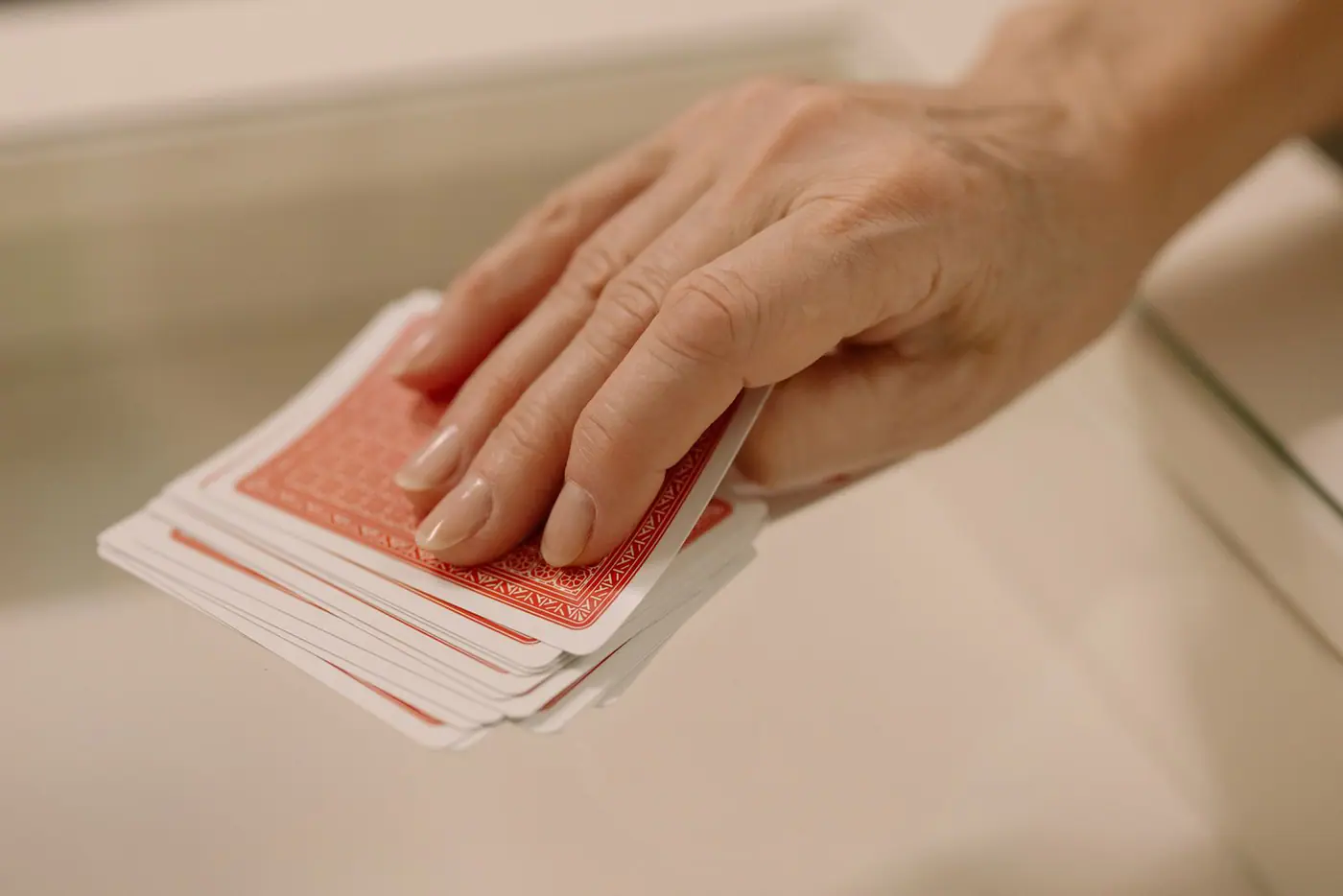
Clean, dry hands are genuinely sufficient for most handling. The common failure is not skin oil — it is grit. A single grain of sand between a thumb and a card face will leave a scratch that shows up under raking light years later.
- Work on a clean, non-abrasive surface — a mat, a cloth, or a sheet of paper.
- Hold cards by opposite edges, never by the face.
- Do not slide a card across a table; lift it.
- If you handle a lot at once, keep a soft brush nearby for dust rather than wiping with a cloth.
A seasonal checklist
Four times a year is enough. The whole routine takes about twenty minutes for a mid-sized collection.
Read the hygrometer
Note the value. Anything persistently above 60% or below 30% deserves attention.
Check the top of each stack
Look for curl under raking light. A flat card in a flat stack is a good sign.
Smell the boxes
A musty or plasticiser smell is the earliest indicator of a problem.
Rotate the browsing binder
If one page is always open to the same spread, that spread is getting the light.
Replace tired sleeves
Any sleeve that is tacky, cloudy or creased is no longer protecting anything.
Log the date
One line in a notebook: date, humidity, anything you changed.
Three storage myths
"Silica packets will keep a box dry."
A small silica packet in a sealed box will absorb a limited amount of vapour and then stop. In a box that is opened regularly, it is saturated within days. Silica is useful for shipping containers that stay closed; it is not a room dehumidifier.
"Vacuum sealing is the safest option."
It removes air, which sounds appealing, but it also applies uniform pressure to every edge and corner and traps any moisture already present against the card. Rigid containers with a stable environment are gentler.
"Sleeved cards cannot be damaged."
Sleeves protect against abrasion, not against bending, heat, light or moisture. A sleeved card left on a sunny windowsill will fade exactly like an unsleeved one.
None of this requires special equipment. A hygrometer, a lid, a box that fits, and a habit of not leaving things in the sun will outperform any amount of expensive storage bought after the damage is done.