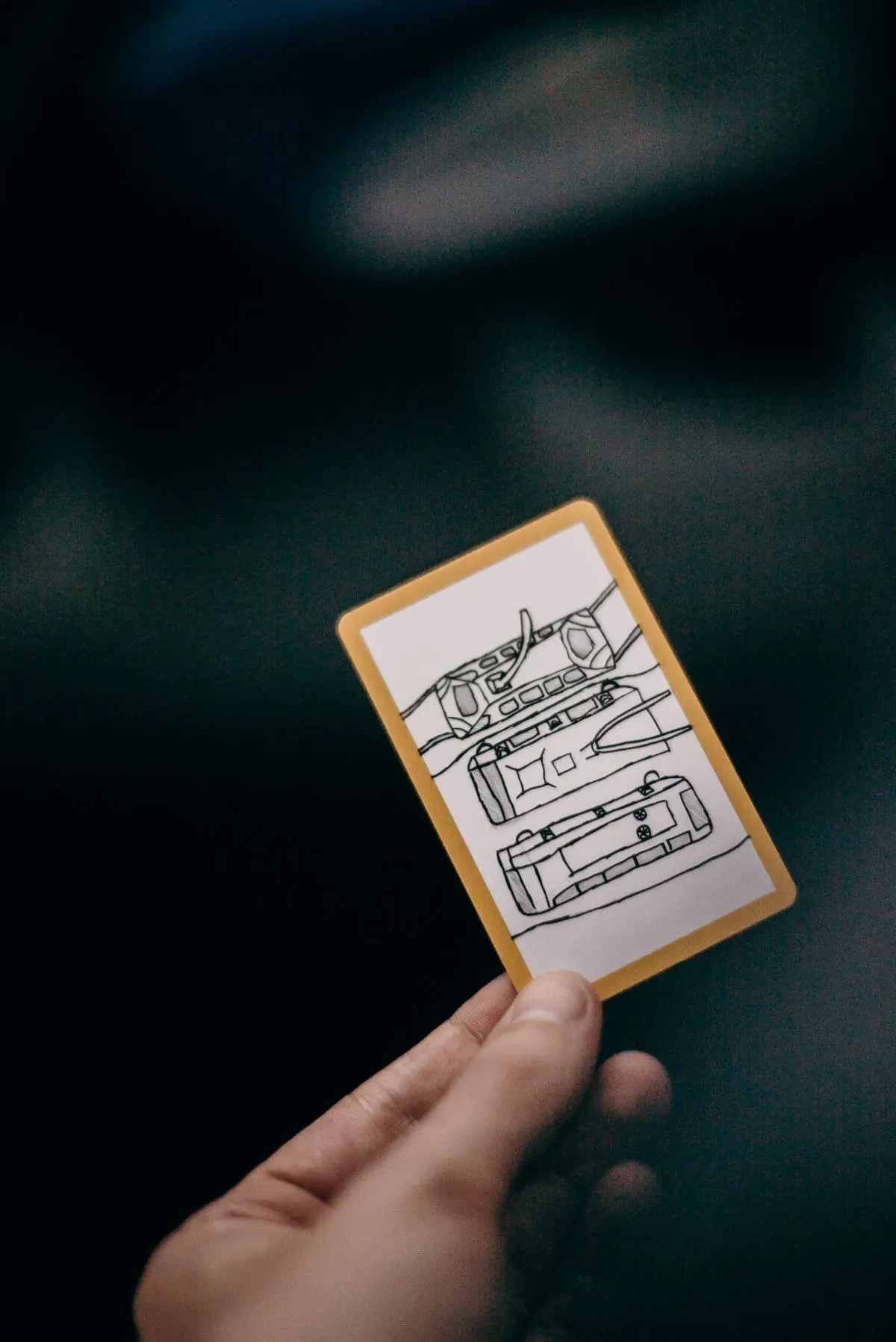
Surface differences are almost always visible in raking light before they are visible at all. The skill is not having better eyes — it is holding the card at the right angle to the right kind of lamp and knowing what each result means.
Setting up a light test
Put the lamp low and to one side, roughly 20–30° above the plane of the table, and about half a metre away. The goal is a long, shallow reflection across the card rather than a bright spot on it. On a dark tablecloth, the card's edge becomes a hard line and the surface becomes a gradient.
Now rotate the card slowly rather than moving the light. The reflection should travel across the surface as one continuous band. Where that band breaks, scatters or changes colour, you are looking at a different material or a different stage of the printing process.
Four finishes, four tells
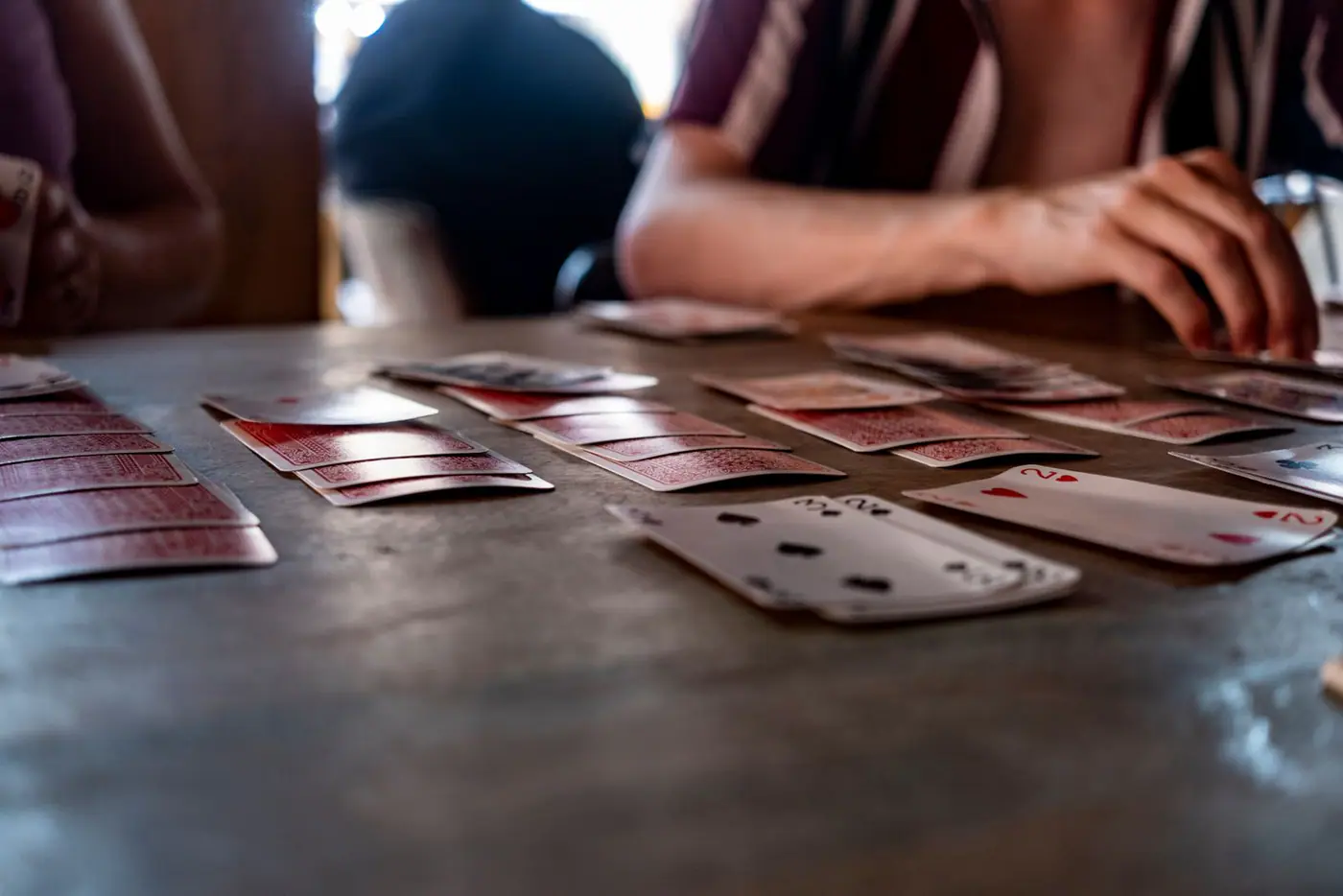
The words people use for finishes are not standardised across the hobby, and manufacturers are inconsistent too. What follows is a working vocabulary based on what the surface actually does under light, not on marketing labels.
Telling foil from etched
Tilt the card through maybe 15° and watch where the shimmer lives. Foil is applied to a printed region, so the shimmer occupies the shape of that region — a border, a symbol, a frame. Etching is a micro-texture stamped across a defined area, so the shimmer tends to follow the geometry of the stamp rather than the artwork.
A second tell: foil usually shifts hue as it rotates, because you are seeing a metallic reflection of the light source. Etching mostly shifts brightness, staying closer to one colour family as the angle changes.
Holding the card without changing what you see
The way you hold a card affects the reading. Fingers press oil onto the surface, which changes the way light scatters and creates exactly the kind of local haze you are trying to look past. Hold the card by opposite edges where possible, and keep it off the table surface — a card lying flat reflects the room, not the lamp.
Print artefacts worth knowing
These are manufacturing signatures, not damage. Being able to name them prevents a great deal of unnecessary worry — and, in the other direction, prevents assuming a card is a reprint when it is simply from a different pass.
| Artefact | What you see | Usual cause |
|---|---|---|
| Dot gain | Text slightly heavier than expected; fine lines fill in | Ink spreading into coated stock under press pressure |
| Registration drift | A colour edge fringed by another channel | Plates not perfectly aligned on that pass |
| Haloing | Pale outline around a dark shape | Knockout gap in the plate, common and benign |
| Roller marks | Faint parallel banding across a flat area | Uneven pressure in the coating unit |
| Foil skip | Small unshimmered patch inside a foiled region | Incomplete transfer during the heat-and-pressure step |
Describing condition so someone else can verify it
Most condition language in the hobby is vague in a specific way: it describes a conclusion ("near mint") instead of an observation ("two faint surface scratches, visible only in raking light, not felt with a fingernail"). The second version is checkable. The first is a claim.
A useful description answers five questions:
- Where is the feature — which corner, which edge, which quadrant of the face?
- How big — in millimetres, not adjectives.
- Under what light is it visible — diffuse, raking, or backlit?
- Can you feel it with a fingernail across the surface?
- Does it cross printed detail, or sit in a flat area?
That last point matters more than it sounds. A mark in a flat area of colour is much easier to see and much easier to assess. A mark that runs across a highly detailed region can be nearly invisible in a photograph and quite obvious in person.
Common misreadings
"The colour is different, so it must be a different print."
Sometimes true, often not. Colour also varies with the light source you are using. Incandescent light pushes everything warmer; a cool LED pushes it blue. Compare two cards under the same lamp, at the same angle, against the same background, before drawing any conclusion.
"It has a scratch, so it is damaged."
Surface marks exist on a spectrum from "visible only at one specific angle" to "removes ink". The first is normal for anything that has been handled. Only the second is a material change to the object, and even then the practical significance depends on what you intend to do with it.
"Foil means it is a premium printing."
Foil is a finishing step, not a quality grade. It adds a manufacturing stage and a failure mode (foil skip) that non-foiled cards do not have. Plenty of foiled cards are less durable than their plain equivalents, because the metallic layer is an additional interface that can separate.
A five-minute routine
This routine will not tell you what a card is worth, and it is not designed to. It will give you a consistent, repeatable description of the object in front of you — which is the only thing any of us can actually observe.